


Employee recognition
10 Types of Employee Recognition (And How to Use Each)
From peer-to-peer to monetary recognition — discover the 10 types of employee recognition that drive engagement and retention. See how Stadium makes each type effortless.






Most recognition programs die in the first six months. Not because the company stopped caring–because the recognition only came in one flavor. A monthly shout-out in Slack. A points balance no one redeemed. A plaque at year five.
Recognition fails when it’s one type doing the work of ten.
That gap shows up in the data. Employees who say they don’t get adequate recognition are twice as likely to say they’ll quit in the next year, per Gallup. The cost compounds: lower engagement, lower retention, higher backfill spend, slower onboarding for the wave that replaces them.
Real recognition programs run on a mix of types–peer-to-peer, manager-led, formal awards, casual thank-yous, monetary rewards, time off, milestone celebrations. The mix is the point. A program that runs only on monthly Slack shout-outs leaves behind the people those shout-outs don’t reach.
This guide breaks down the 10 types of employee recognition, when to use each, and how to actually run them together inside one program–without buying a different vendor for every type.
The 10 Types of Employee Recognition
Here’s the practitioner’s toolkit, in ten pieces. A few of these run every day; others fire once a year. Some come from peers, some from managers, some from the company. They aren’t substitutes for each other, even when they look similar on paper.
1. Peer-to-Peer Recognition
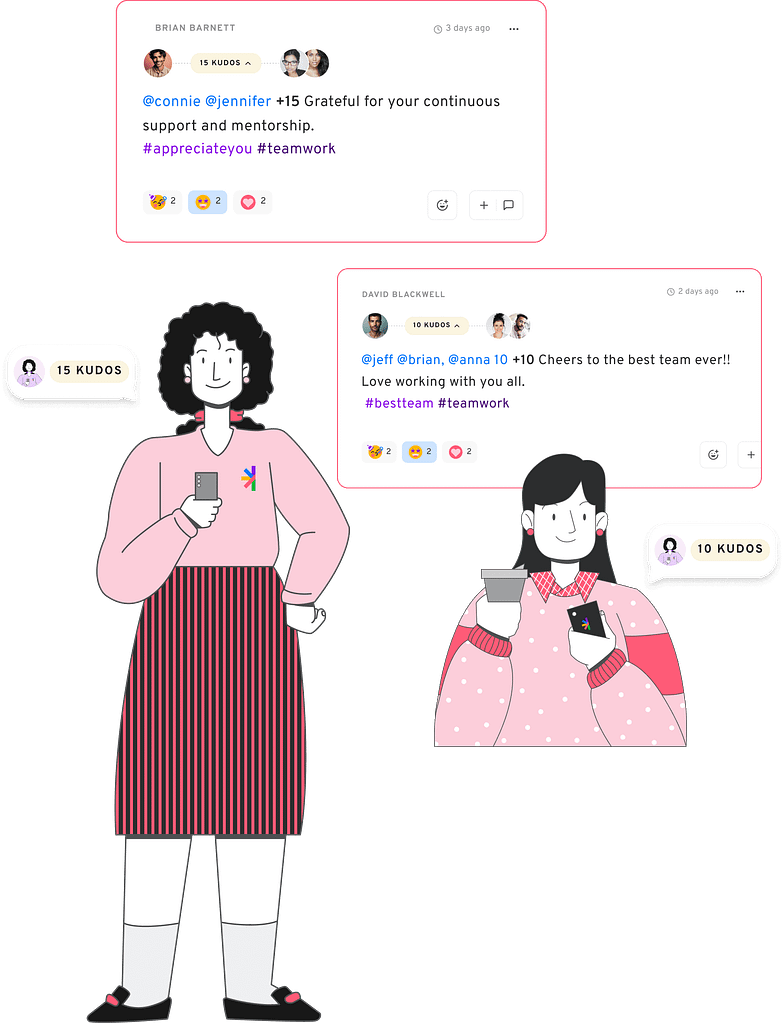
Peer-to-peer recognition is employee-to-employee acknowledgment–coworkers, not managers, doing the recognizing. When it runs inside a feed or a points system, it’s often called a kudos program. The kudos program is a feature of the recognition program, not a substitute for it.
When to use it. Daily moments. Cross-team handoffs. Behaviors managers don’t see–the late-night code review, the calm during a client escalation, the new hire who got onboarded by a peer because the manager was in back-to-backs.
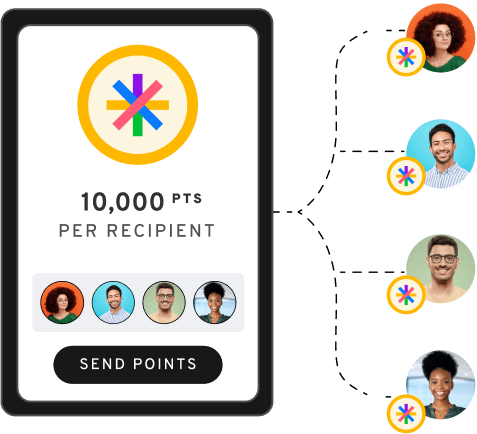
How to deliver it well. Make it easy (under 30 seconds to send), visible (the team feed, not a private DM), and tied to a company value when possible. Pair it with a small reward–a snack box, a gift card, a Stadium Points balance the recipient can spend on what they actually want. Words are fine on their own. Words plus a $10 snack box show up in someone’s week in a way a thumbs-up emoji never will.
What to avoid. A peer-recognition tool nobody uses. Most fail for one of three reasons: it takes six clicks to send a kudos, the rewards catalog is bad, or the budget structure makes peers feel awkward “spending” recognition on each other. Peer recognition stops the moment peers start carrying the budget guilt.
2. Manager-to-Employee Recognition
Manager-to-employee recognition is acknowledgment that flows downward–from direct manager, skip-level, or executive–for performance, behavior, or effort.
When to use it. Performance milestones. After a project ships. During 1:1s. For behaviors the manager wants to reinforce: “I noticed how you handled the support ticket yesterday–that’s the standard.” Also for the under-recognized work–the thankless tasks that hold a team together but never show up in a review.
How to deliver it well. Specificity beats frequency. “Great job” is empty. “The way you triaged the bug yesterday saved us a customer” is recognition. For the bigger moments, pair the words with something tangible: a gift card, a swag kit, a day off.
The bottleneck. Only about one in three workers strongly agree that they received recognition or praise for doing good work in the past seven days, per Gallup. The gap isn’t intent–most managers want to recognize their teams. The gap is execution: the tool is too cumbersome, or they forget, or the recipient is in another country and the gift takes three weeks to arrive.
3. Employee-to-Leader Recognition (Bottom-Up)
Employee-to-leader recognition is acknowledgment that flows upward–employees recognizing managers and executives for their support, mentorship, or impact. It’s the most under-covered type in the field.
Why it’s overlooked. Most recognition programs assume value flows top-down. They forget leaders are humans who burn out too. Recognition for leaders signals that the program is for everyone–not a tool managers use on their teams.
When to use it. Boss’s Day. Manager work anniversaries. After a leader does something visibly hard: defending the team’s budget, navigating a layoff, hiring well, holding the line on a deadline that would have crushed the team. Or just because–leaders rarely get acknowledged for the calm-in-the-room work that keeps everyone else upright.
How to deliver it well. Keep it optional. The minute upward recognition becomes required, it reads as performative–and everyone, including the leader on the receiving end, can tell. Use the same tool the team already uses for peer recognition rather than spinning up a separate “thank your boss” workflow that nobody finds. Budgets here should stay modest; the recognition is the point, not the gift size. Leaders rarely get acknowledged for the calm-in-the-room work, and on most platforms there isn’t even a clean way to try.
4. Team and Company-Wide Recognition
Team recognition acknowledges a group’s contribution–a squad that shipped a project, a department that hit a goal, a cross-functional pod that pulled off something nobody owned alone. Company-wide recognition is the same energy at scale–entire-company moments like Employee Appreciation Day, holiday recognition, the anniversary of the founding.
When to use it. Project wins. Quarter wraps. Cross-functional collaborations no single person owns. Annual celebrations. Anniversaries that touch the whole company.
How to deliver it well. Group rewards land harder when each person picks their own item. A 50-person team handed identical swag kits feels like a uniform. A 50-person team where each picks their own snack box, gift card, or piece of swag feels like a thank-you.
The global problem. Most team rewards are designed for the home office. The teammate in Manila or São Paulo gets nothing–or a delayed package with $80 of customs fees. That kills the moment. The recognition arrived; the recognition also arrived two weeks late and cost more in fees than it cost to send.
5. Public Recognition
Public recognition is acknowledgment delivered in front of others–the all-hands callout, the team-channel shout-out, the company-wide message, the LinkedIn post celebrating a team member’s promotion.
When to use it. When the goal is visibility–to reinforce values across the org, to make a behavior contagious, to mark a moment in front of peers who can pattern-match against it.
The introvert caveat. Not everyone wants to be celebrated publicly. Read the room. For employees who’d rather not be on stage, pair the recognition with a private follow-up–a personal note, a private gift, a one-on-one acknowledgment from a manager. The Feed can show the recognition publicly while the gift itself stays personal between sender and recipient.
How to deliver it well. Specificity scales. “Great job, team” gets ignored. “Marketing shipped the Q1 campaign two weeks early and pulled in 30% more leads–here’s who did what” gets quoted back in the next standup and becomes the template for the next campaign. Public recognition is only as valuable as the specificity behind it.
6. Milestone and Work Anniversary Recognition

Milestone recognition marks the time-based moments–work anniversaries, years-of-service awards, retirements, promotions, project launches, the first year, the fifth, the tenth.
Why this type cannot be manual. HR teams of one miss anniversaries. Managers forget birthdays. The result: the most meaningful moments–the ones that say “we noticed you’ve been here five years”–get skipped. That’s a retention failure dressed as an oversight.
How to deliver it well. Tier the awards. A one-year mark might be a snack box. A five-year mark might be a premium swag kit with a handwritten note from leadership. A ten-year mark might be an experience or a substantial milestone gift the employee picks themselves. Use the same milestone catalog across the company–consistency reinforces fairness, and people compare notes.
The global problem, again. A milestone gift that arrives three weeks late and costs $80 in customs fees is worse than no milestone gift. The whole point of milestone recognition is that the timing is the message: we noticed the exact day.
7. Monetary Recognition
Monetary recognition is acknowledgment with direct financial value–spot bonuses, gift cards, rewards points redeemable for cash equivalents.
When to use it. Above-and-beyond performance. Retention moments. Behaviors you want to lock in. Cash signals weight in a way verbal recognition can’t.
The cash-vs-tangible debate. Cash is forgettable. A $200 cash bonus disappears into the Visa statement and ends up paying the gas bill. A $200 experience, gift card, or premium kit the employee picks for themselves becomes the story they tell at the next team lunch. The Incentive Research Foundation has documented this pattern in study after study on non-cash incentives: tangible rewards and experiences tend to be more memorable per dollar than equivalent cash, especially when the recipient gets a say in what they receive. (Note for editor: confirm the specific IRF paper URL before publication–see theirf.org/research.)
How to deliver it well. Use recipient choice. A $100 monetary recognition where the employee picks between a gift card to their favorite store, a snack box, a piece of swag, or a charitable donation lands far harder than a $100 transfer. The CFO sees the budget; the recipient feels the choice.
Paperchase, the accounting and financial services firm, runs monetary recognition this way. They came to Stadium wanting to integrate their branded logo into employee gift merchandise–each employee getting a specific budget range to spend through a branded shop. Stadium built them a custom Stadium Shop with Paperchase's logo prominently featured, multi-order capability, and per-recipient allocated budgets pulling from a curated catalog. The outcome is described on the case study page in the HR team's own words: "Paperchase's HR team is happy with the shop that prominently features its logo… The recipients are filled with excitement as they select items they can use, and this experience instills a sense of pride in being a Paperchase employee." The cash bonus would have disappeared into a Visa statement. The branded shop became a brand moment every recipient remembers
8. Non-Monetary Recognition
Non-monetary recognition acknowledges without a direct cash value–time off, flexible hours, growth opportunities, public credit, experiences, premium swag, snacks delivered to the desk on a hard day.
When to use it. When the budget is small. When the recipient already feels well-compensated and another $100 bonus won’t register. When the gift needs to feel personal, not transactional.
The premium trio. Non-monetary doesn’t mean cheap. A premium curated snack box from Snackmagic says, “we know what you like.” A custom swag kit from Swagmagic says, “you’re part of this team.” An experience–a class, a wellness day, a coffee subscription–says, “we want you to have a good day.”
How to deliver it well. Personalization matters more than cost. A $20 snack box that actually fits the recipient’s dietary needs beats a $50 generic mug, because someone clearly thought about it. The Stadium catalog of 25,000+ premium curated products covers the full range, so the same program can send a $10 thank-you, a $50 mid-tier kit, or a $500 milestone experience without bouncing between vendors and contracts. It’s curated rather than sprawling–every item is something you’d actually want to send.
9. Formal / Structured Recognition
Formal recognition is the scheduled, structured side of the program: annual awards, quarterly bonuses, named ceremonies, leveled tiers tied to specific criteria. If informal recognition is the texture of the workplace, formal recognition is its architecture.
When to use it. When the recognition needs weight: visibility, ceremony, public reinforcement of what the company values. Performance awards. Years-of-service awards (covered in detail at type 10). Innovation awards. Customer-impact awards. Anything that says, “this is what we hold up as the standard.”
How to deliver it well. Clear criteria–people should know how to win. Public reveal–the formality is the point. Tangible reward that matches the weight of the moment: a $50 gift card on a plaque feels symbolic. A $500 experience or a premium curated kit from Stadium Packages feels like an award.
The trap. Formal recognition with opaque criteria, or the same three winners every year. Either one will kill morale faster than no recognition at all–because now the program reads as favoritism with a trophy attached. The fix isn’t complicated: make the criteria visible, vary the winners, and make sure the reward feels like an award, not a $50 Visa card stapled to a plaque.
10. Informal / Day-to-Day Recognition
Informal recognition is the spontaneous, in-the-moment acknowledgment that happens daily–a thank-you in standup, a Slack shout-out, a handwritten note left on a desk, a quick snack delivery to someone working through a hard week.
Why it matters most. Frequency beats grandeur. Daily informal recognition does more for engagement than an annual gala–the gala is a memory, but informal recognition is what the workplace actually feels like for the other 364 days.
The two flavors. Public informal–the team-channel shout-out, the standup callout, the company-wide message. And private informal–the DM, the handwritten note left on a desk, the quiet “I saw what you did” message that doesn’t need an audience.
How to deliver it well. Keep it low-friction. Upgrade it when it matters. A Slack thank-you costs nothing. A Slack thank-you paired with a $10 snack delivery costs $10–and feels ten times heavier. Quick Recognize handles the 30-second moment; the Stadium Wallet handles the per-manager budget so the upgrade from words to a small tangible gift doesn’t require a separate vendor or a separate approval. Frequency beats grandeur. A weekly $10 snack box does more than an annual gala–and costs less than catering.
What Recognition Do Employees Value Most?
Employee recognition ideas are not one-size-fits-all. Each individual values different forms of appreciation based on their personal preferences, career goals, and workplace expectations.
To build a truly positive work environment, companies need to understand what resonates most with their employees and implement a well-rounded recognition program.
While some employees thrive on public appreciation and team-wide acknowledgment, others find more value in private recognition, career advancement opportunities, or personalized rewards.
The key to effective program is customization—ensuring that appreciation efforts align with what employees genuinely appreciate. Organizations that prioritize meaningful recognition see enhanced employee engagement, motivation, and long-term loyalty.
1. Understanding What Today’s Employees Want
The modern workforce is diverse, with varying expectations regarding how they like to be recognized in the workplace. Today’s employees value frequent recognition, meaningful feedback, and a blend of monetary and non-monetary appreciation.
However, what makes a program truly effective is personalization—tailoring recognition to suit individual preferences.
For example, some employees may prefer public acknowledgement, such as a LinkedIn shoutout or a feature in a company newsletter, while others may feel more valued through private appreciation, such as a direct message from their manager or a handwritten thank-you note.
Offering a variety of recognition methods ensures that all employees feel seen and appreciated in ways that matter most to them.
Stadium helps organizations create a culture of togetherness by offering a range of employee recognition solutions that allow employers to customize rewards and acknowledgment efforts.
Whether it’s a platform for peer-to-peer appreciation or a system that tracks and celebrates milestones, Stadium ensures that employees receive recognition in meaningful ways.
2. Monetary vs. Non-Monetary Recognition
Recognition in the workplace involves more than just financial rewards. While bonuses, salary increases, are valuable, employees also appreciate non-monetary recognition that makes them feel respected and valued beyond their paycheck.
Monetary recognition includes:
- Performance-based bonuses
- Salary raises
- Gift cards
- Profit-sharing incentives
Non-monetary recognition includes:
- Career development opportunities (training programs, mentorship)
- Public appreciation (company-wide emails, recognition events)
- Additional paid time off (flexible work schedules, wellness days)
- Personalized gifts and experiences
Stadium’s employee recognition platform provides companies with flexible options for both monetary and non-monetary recognition. Employers can reward employees with custom gifts, branded swag, experience-based rewards, and professional development opportunities—all tailored to individual preferences. By providing employees with a wide variety of recognition choices, companies can ensure that appreciation helps employees feel truly valued.
3. Celebrating Milestones and Work Anniversaries
Acknowledging years of service, birthdays, and career milestones is a crucial aspect of employee recognition. Celebrating these moments reinforces an employee’s connection to the company and highlights their contributions over time. Employees who receive milestone acknowledgement feel a greater sense of belonging, which leads to enhanced employee engagement and job satisfaction.
Common milestone celebrations include:
- Work anniversaries (5, 10, 15 years of service)
- Promotions and career advancements
- Birthdays and personal achievements
- Completion of major projects
Example: A company using recognition solution can celebrate an employee’s years of service with a personalized milestone gift box, including custom company swag, a handwritten appreciation note from leadership, and a feature on the company’s recognition platform. Additionally, tools enable companies to schedule automated milestone reminders, ensuring that no achievement goes unnoticed.
By incorporating milestone recognition into a structured program, companies can create an environment where employees feel valued throughout their careers, increasing retention and overall workplace satisfaction.
How to Run All 10 Types Inside One Recognition Program
Here’s the trap most HR teams fall into. A Slack bot for peer-to-peer. A separate platform for years-of-service awards. A gifting tool for client and employee milestones. A swag vendor for branded kits. A snack subscription for the office.
Each one comes with its own contract, login, budget line, and reporting view, and somehow they all renew in different months. The result is a Frankenstein program: high logistics drag, no single source of truth, and a recipient experience that depends entirely on which vendor’s tool the manager happened to open that morning.
The integrated model runs differently. One platform handles all 10 types. One catalog covers every reward. One budget engine controls who can spend what. One automation layer runs the milestone calendar. One fulfillment network delivers locally everywhere. One reporting view shows what’s actually happening.
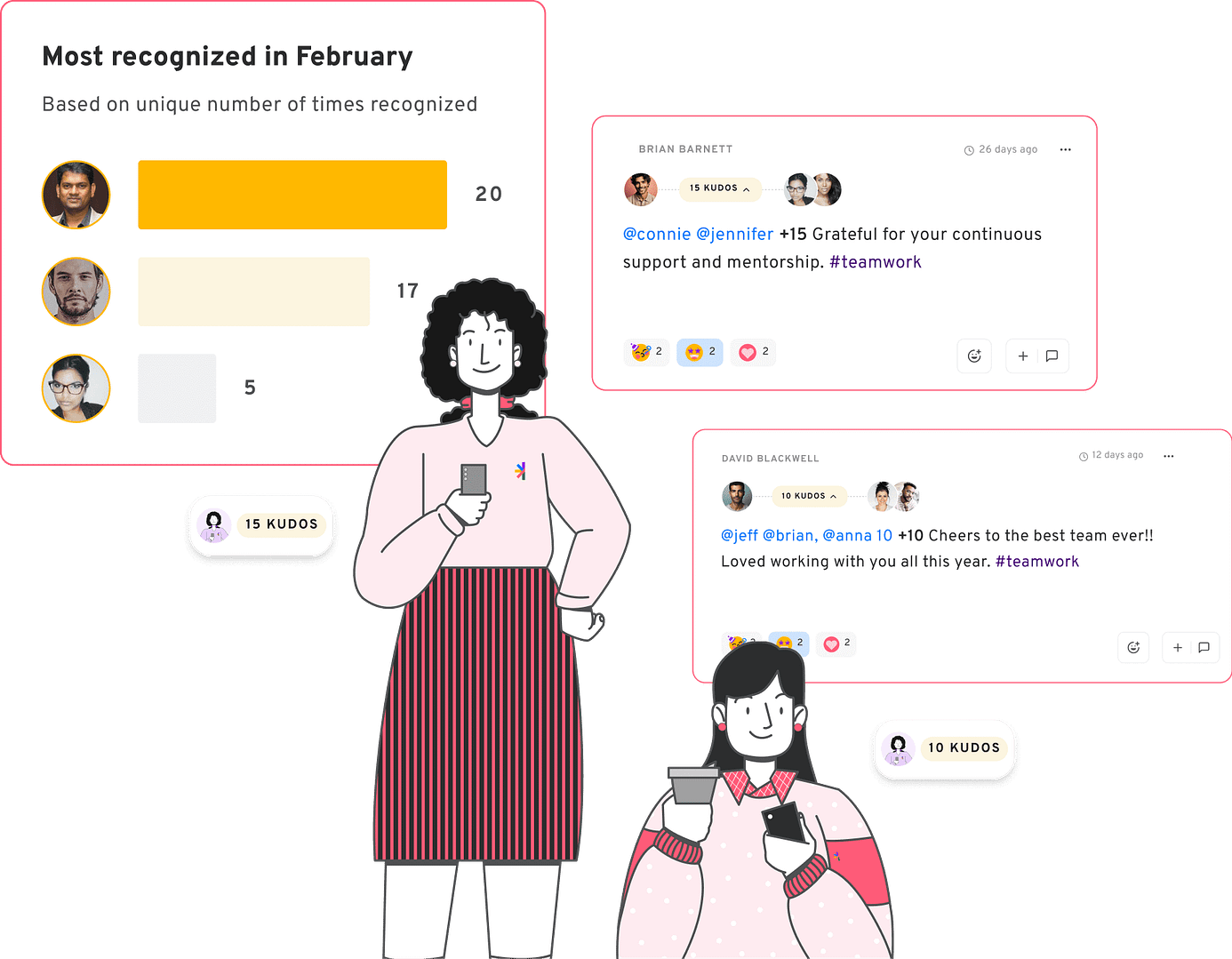
- One platform. Stadium Workspace handles peer-to-peer, manager-led, employee-to-leader, milestone, and public recognition–all in the same product.
- One catalog- 25,000+ premium curated products
- One budget engine- Stadium Wallet handles per-person, per-team, or per-program budgets
- One automation layer- 100+ integrations connect it to the HRIS, Slack, Teams, and the rest of the stack.
- One fulfillment network- 170+ countries, 500+ warehouses.
- One reporting view- Workspace and the Shop Dashboard track recognition activity across every type, every team, every region.
“We cut 9 vendors, saved a ton of money, and took our engagement to an all-new level.”

Nish Patel, CEO, Paperchase
Curious how this runs in your workflow?
FAQ's Related to Types of Employees Recognition
The main types of employee recognition are public recognition, private recognition, employee-to-employee (peer) recognition, formal and structured recognition, informal recognition, milestone recognition, monetary recognition, non-monetary recognition, and values-based recognition. Most effective programs combine several types rather than relying on just one — because different employees respond to appreciation in different ways.
The four core types are formal recognition (structured programs like Employee of the Month or tenure awards), informal recognition (spontaneous verbal praise or thank-you messages), peer recognition (appreciation between colleagues rather than from management), and monetary recognition (bonuses, gift cards, or reward points). Together, these four cover the most common ways organizations acknowledge employee contributions.
Formal recognition is planned and structured — think annual excellence awards, quarterly nomination programs, or service milestone ceremonies. Informal recognition is spontaneous and unstructured — a verbal “great job” in a meeting, a quick message after a big presentation, or an unexpected shoutout in a team channel. Both matter: formal recognition carries weight and visibility, while informal recognition creates the day-to-day frequency employees need to feel consistently valued.
Research consistently shows that the most effective recognition is timely, specific, and personal — not a particular type. That said, combining public recognition (for visibility) with private recognition (for personal impact) tends to produce the strongest results. Gallup data shows employees who receive meaningful recognition are 4x as likely to be engaged at work. The key is making recognition frequent and tailored to how each individual prefers to be appreciated.
Monetary recognition involves financial rewards — performance bonuses, gift cards, salary increases, or a points-based reward system employees can redeem. Non-monetary recognition includes public praise, career development opportunities, extra time off, personalized experiences, or branded company swag. Research consistently shows that non-monetary recognition — especially when it’s personal and timely — often produces stronger engagement than financial rewards alone, because it signals genuine appreciation beyond a transaction.
Start by mapping which recognition types your organization currently uses — most companies default to formal, top-down recognition and miss the rest. Then layer in: an employee-to-employee recognition channel (so praise flows in all directions), a milestone tracking system (so no work anniversary or birthday goes unnoticed), and a values-based nomination process (so recognition reinforces culture, not just output). The best programs don’t require a large budget — they require consistency, a clear system, and the right tools to make it easy for everyone to participate.

