


Employee recognition
Best Employee Recognition Software
Employee recognition software for global companies: 12 platforms reviewed, 8 buyer criteria, and a 4-step framework for HR and Chief of Staff teams.
Most recognition programs die in the first six months. The team didn’t lose interest. The platform’s logistics did them in.
You’ve probably seen one version of it. The HR Director shipping packages from her apartment because the “global vendor” only really ships from a U.S. warehouse. A points balance employees can’t actually redeem. A milestone gift that reaches an overseas employee three weeks late, with a customs bill at the door.
Engagement at U.S. workplaces is at a 10-year low, with only 31% of employees engaged at work (Source: Gallup, State of the Global Workplace, 2024). The cost of getting recognition wrong keeps climbing. Picking a employee recognition platform that hands you a Slack feed instead of a recognition program is the fastest way to spend that cost.
Most listicles in this category will hand you the same shortlist of adjectives. Powerful. Scalable. Smooth. None of it tells you what life looks like in year two of running the program. None of it separates the platform that makes recognition land in Manila from the one that quietly stalls when a snack box gets stuck in customs.
Table of Contents
What is Employee Recognition Software?

Employee recognition software is a platform that helps companies acknowledge, reward, and celebrate employees through structured kudos, automated milestone gifting, and reward fulfillment.
The category is a spectrum. At one end: pure-digital points-and-Slack tools. A peer-bonus layer that lives inside your messaging app, with a generic catalog you redeem from later. At the other end: platforms that combine recognition with physical fulfillment. Branded swag kits, snack boxes, curated gift cards, premium experiences, delivered locally to whoever the recipient is.
What you need depends on what your program has to deliver. A 30-person startup that wants peer kudos in Slack has nothing in common with a 5,000-person enterprise running global service awards alongside client gifting. Same category. Different platforms entirely.
8 criteria for choosing Recognition Software
Most lists in this category collapse into thirteen variations of the same generic adjective. The criteria below are the ones buyers actually have but rarely see in print. Cover these and your shortlist is half-built before the first demo.
Recognition delivery: what arrives, not what gets posted
When someone gets recognized, what actually shows up on the other end? A digital badge, a gift card link, a snack box, a swag kit, a premium gift?
The reward delivery mechanism is the moment recognition becomes something employees remember. Pure-digital points ledgers sit at one end of the spectrum: a Slack post and an abstract redemption later. Physical-fulfillment platforms with curated catalogs sit at the other: something arrives at the door.
For a mid-market HR team, the "arrives at the door" moment is what employees talk about and what justifies the budget at renewal time. A snack box arrives. A gift card arrives. A Slack post does not.
Global fulfillment: local delivery in 170+ countries
Two things tend to get conflated here: "we ship internationally" and "fulfilled locally." They aren't close to the same thing.
International shipping from a single hub usually means one warehouse, customs paperwork, 14-day transit, and the occasional returned mail. Local fulfillment means regional warehouses, no customs drama, 3 to 7-day transit, and no surprise duties for the recipient.
The whole question for a global program comes down to whether the gift arrives in Manila, São Paulo, or Bristol the same way it arrives in Boise. Four problems hit teams who pick the wrong model: customs delays, duty surprises at the recipient's door, returned packages, and inventory sitting at HQ waiting on outbound shipments.
Multi-audience capability: employees, clients, partners, prospects
Most recognition software boxes itself into "employee-only." That choice quietly costs you twice.
The same engagement engine should serve clients on a renewal cycle, partners closing co-marketing campaigns, and prospects in an ABM motion. The workflow is identical: pick the gift, send the gift, fulfill the gift, track the gift. Splitting it across separate vendors is where engagement strategies fragment, and where invoices multiply.
Multi-audience capability collapses your vendor count. A recognition tool plus a sales-gifting tool plus a client-thank-you tool plus an event-swag tool becomes one platform. HR teams that share a budget line with Marketing or Sales benefit. So do Chiefs of Staff consolidating engagement vendors and Operations leaders who own the engagement function as a whole.
Scale flexibility: 1 sender to 1,000+, same platform
Pricing-per-user-per-month traps companies in a category. The platform you pick at 50 employees often isn't the platform you keep at 5,000, and the migration is painful.
What you want is a platform that scales linearly without re-implementation: same UI, same admin, same integrations, just more seats and budgets. Enterprise teams need governance that grows with size: multi-admin permissions, role-based access, budget oversight, brand-asset control. Mid-market teams need lift-light setup: templates, automations, fast onboarding. The right product compresses both.
Stadium runs from 1 sender to 1,000+ on the same platform. Multi-admin permissions, the Automation Dashboard, the Shop Dashboard, and Stadium Packages all flex with size. No re-implementation when you grow.
Automation depth: milestones, anniversaries, onboarding kits
Recognition that runs itself is the only kind that scales for an HR team of one.
Test these in every demo: birthday recognition with a points balance, work-anniversary milestones (1, 3, 5, 10, and 25-year), onboarding swag kits triggered from a new HRIS record, return-to-office kits, performance-cycle thank-yous. Each one removes a calendar-management task from your week and replaces it with an event the program handles on its own.
The cost of not automating is brutal in a way that's easy to dismiss in a demo and hard to ignore in month three. Missed birthdays. Late milestones. The HR team chasing 14 birthdays the day they happen, then 14 anniversaries next month. Recognition becomes a calendar job, not a culture job.
Catalog quality: curated, not Amazon firehose
Catalog quality is where buyers tend to under-invest in their evaluation. They count SKUs and call it a day.
"Access to Amazon" is a feature, not a differentiator. Any platform can plug into a marketplace API. The harder questions: what's curated above and beyond? Snack boxes you'd actually be happy to receive, branded swag kits with quality control, regionally-relevant gift cards, curated experiences? A 200,000-SKU catalog of generic accessories is a different product than a 25,000-SKU catalog of premium curated items.
Compare catalog quality, regional relevance, and the proportion of curated items. The reward should feel like recognition, not a transaction loop.
Stadium's curated catalog spans 25,000+ products: snack boxes, custom swag kits, gift cards, and curated experiences. MagicLink™ lets the recipient choose what's right for them. The recipient picks. The sender doesn't have to guess.
Integrations: HRIS, Slack, Teams, Outlook, Workday
Integration depth is what determines whether recognition lives where employees already work or sits in a silo no one logs into.
The must-haves: HRIS integrations (UKG, Workday, BambooHR, ADP) so onboarding triggers automatically; Slack, Microsoft Teams, and Outlook so recognition surfaces where employees already are; SSO (Okta, Azure AD) so login is invisible; reporting connections to BI tools so the analytics flow back to leadership. "Good integration" looks like bi-directional, real-time, and no manual CSV uploads.
This is the spot where adoption goes to die. If recognition isn't in the tools employees already use, it stalls in week three and the program quietly disappears in month nine. Stalled adoption is the number-one reason recognition programs don't survive year two.
Stadium runs 100+ integrations across HRIS, Slack, Teams, Outlook, and SSO. New hire added to UKG, swag kit triggered in 60 seconds, arrives at the door in 5 days. Stadium plugs into the tools you already run.
Reporting and analytics: coverage, equity, ROI
Recognition without measurement is just a budget line. The CFO will eventually cut it.
Four metrics worth requiring. Recognition coverage: what percent of the workforce got recognized in the last 90 days. Recognition equity: whether recognition concentrates on the same 20% of employees or spreads across teams. Program ROI: engagement and retention deltas tied to participation. Budget burn-down: per-team and per-region, so leaders can flex.
Without these, the program runs blind and budget renewal becomes a fight every year. With them, you walk into renewal with a dashboard.
Stadium's Automation Dashboard and Shop Dashboard give admins coverage by team, equity by tenure, and ROI by program. Three views that survive a CFO review. Multi-admin views let regional owners see their slice without losing centralized oversight.
12 Employee Recognition Software
Stadium goes first because it’s the most-developed entry. The other platforms are grouped into nine archetypes, categories of recognition software defined by capability rather than by brand. Archetype thinking is a stronger buyer-education frame than a head-to-head brand comparison, and it lets the article describe what each category actually does without picking fights with vendors who answer to different buyers.
1. Stadium: Enterprise-grade Recognition + Swag + Snack + Gifting on one Global Platform
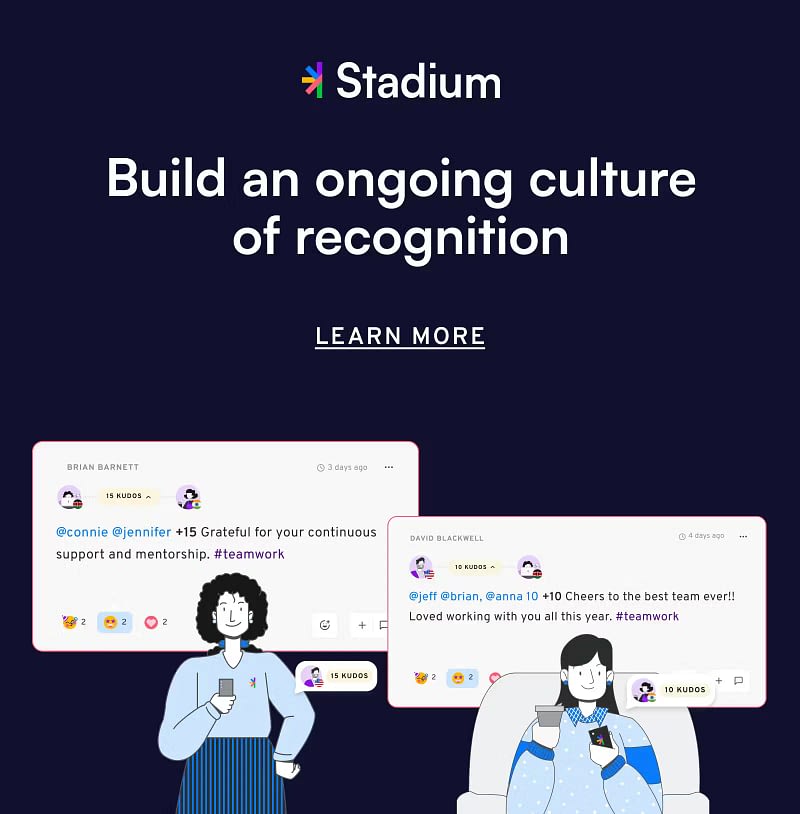
Stadium is a single platform for recognition, branded swag, snack boxes, and curated gifting, fulfilled locally in 170+ countries and scaling from 1 sender to 1,000+. It’s built for enterprise governance and global fulfillment, with the implementation speed and pricing flexibility most enterprise platforms don’t offer. Stadium also serves employees, clients, partners, and prospects on the same platform, which is uncommon in the category.
Best for: Enterprise and global HR teams that want recognition, swag, snack boxes, and gifting in one platform. Chiefs of Staff consolidating engagement vendors across HR, Marketing, Sales, and Events. The platform also serves mid-market HR teams that want enterprise-grade governance without an enterprise implementation timeline. Chiefs of Staff at 5,000+ companies and HR Directors at ~300-employee companies both land here for the same reasons: vendor consolidation, global reach, and governance that flexes with size.
Pricing: Custom. Scales with sender count, regions served, and delivery formats. No per-user-per-month trap. Premium features free for 30 days for evaluation.
Key features: Stadium Shops, Stadium Points, MagicLink™, automated milestone and onboarding gifting, the Automation Dashboard, the Shop Dashboard, multi-admin permissions, role-based access, Shared Wallet, Stadium Wallet, Stadium Packages, Peace of Mind Protection, Snackmagic, Swagmagic, 100+ integrations (UKG, Workday, BambooHR, ADP, Slack, Microsoft Teams, Outlook, Okta, Azure AD), and a 25,000+ product curated catalog spanning gift cards, premium swag, snack boxes, and curated experiences. Roll-up reporting on coverage, equity, and ROI for HR leadership and CHRO presentations.
Strengths:
- The only platform in this guide that bridges all four delivery formats globally: recognition, swag, snack boxes, and gifting.
- Local fulfillment in 170+ countries through 500+ warehouses removes customs and inventory drama, an angle enterprise behavioral-science platforms typically can’t claim because they rely on third-party rewards marketplaces rather than owned regional inventory.
- Multi-audience capability collapses 4 to 9 vendors into one. The 1 to 1,000+ scale flex means no re-implementation as the company grows.
- Automation depth covers birthdays, milestone anniversaries, onboarding kits, and HRIS-triggered programs out of the box.
- Enterprise-grade governance, with multi-admin permissions, role-based access, regional admin coverage, brand-asset control, and budget oversight, without the 60 to 90-day implementation timeline most enterprise platforms require.
- 10,000+ companies use the platform, including Salesforce, Amazon, Microsoft, Dell Technologies, Hewlett Packard Enterprise, GE, BP, Deloitte, Gartner, UKG, Keyfactor, isolved, Paperchase, Wolters Kluwer, and Foursquare.
“We cut 9 vendors, saved a ton of money, and took our engagement to an all-new level.”

Nish Patel, CEO, Paperchase
2. Enterprise rewards-marketplace platforms with Amazon integrations
This archetype’s whole pitch is a rewards marketplace integrated with Amazon’s catalog. The platform layer sits on top: a points engine, milestone tracking, manager-driven recognition.
Best for: Enterprises that want a broad, generic catalog and don’t want to curate it. Service-award and tenure-program use cases where catalog breadth matters more than catalog feel.
Pricing: Custom enterprise.
Key features: Amazon-backed catalog, points engine, milestone tracking, service awards, light recognition workflows, basic peer-recognition feeds, gift-card redemption fallbacks for regions where Amazon is thin.
Strengths: Catalog breadth from Amazon’s SKU base. Familiar shopping experience for recipients in the U.S. Comfortable for buyers who want a known quantity behind the redemption layer. Implementation is typically faster than the behavioral-science archetype because the platform leans on Amazon’s infrastructure rather than custom logistics.
Watch-outs: The catalog is generic, not curated, so recognition often feels transactional, like a points-then-Amazon transaction loop. The Amazon dependency is shared by the whole archetype, which means the differentiation between vendors is thin and pricing competition is brutal. Premium recognition moments (snack boxes, curated swag kits, branded onboarding kits) usually require a separate vendor. Amazon’s regional reach is real but uneven; the recipient experience in countries where Amazon is thin (parts of LATAM, MEA, SE Asia) can fall apart in ways the platform’s product page doesn’t surface.
3. Bonusly: Slack-native peer-bonus recognition

Pick a Slack-native peer-bonus tool and adoption flies in week one. Year two is where the gaps surface.
Bonusly is the lightweight peer-recognition platform built for teams that live inside Slack or Microsoft Teams. Employees give each other small point bonuses for a job well done, and points convert into gift cards, charitable donations, or company swag. Pricing sits at roughly $2.70–$5 per user per month, with a free tier for small teams.
Best for: small-to-mid teams (50–500 employees) that want a fun, frequent peer-recognition layer inside the chat tool their team already uses every day.
Key features
- Peer points and bonuses inside Slack and Microsoft Teams
- Social recognition feed visible to the whole team
- Automated birthday and work-anniversary milestones
- Gift-card and donation redemption catalog
- Basic reporting on recognition frequency and participation
Strengths
Setup is fast. Admin overhead is low. The casual chat tone keeps recognition flowing–a sender can recognize a teammate in under 30 seconds without leaving the workflow they’re already in.
4. Achievers: Enterprise behavioral-science recognition

Some platforms are built for an HR team of one. Achievers isn’t.
Achievers is the enterprise recognition platform anchored in behavioral-science research from the Achievers Workforce Institute. The product targets organizations with 500+ employees that want recognition, rewards, and analytics in one workspace, backed by a partnership team that helps roll the program out across regions. Pricing is custom enterprise–no public per-seat number–and implementations typically run 60–90 days.
Best for: enterprise organizations 500+ employees with budget for a behavioral-science partner and the change-management bandwidth for a multi-month rollout.
Key features
- AI-powered recognition insights and manager nudges from the Achievers Workforce Institute
- Global rewards marketplace covering ~190 countries
- Recognition data analytics tied to engagement and retention metrics
- Deep HRIS and HCM integrations (Workday, SAP SuccessFactors, ADP)
- 24/7 multilingual customer support and dedicated customer success managers
Strengths
The research depth is real. Manager nudges and recognition-frequency dashboards are actionable, not decorative. For enterprise teams that already have the budget, the bandwidth, and a 90-day onboarding window, this is a serious platform.
5. Awardco
Big catalogs aren’t always better. Curated catalogs land.
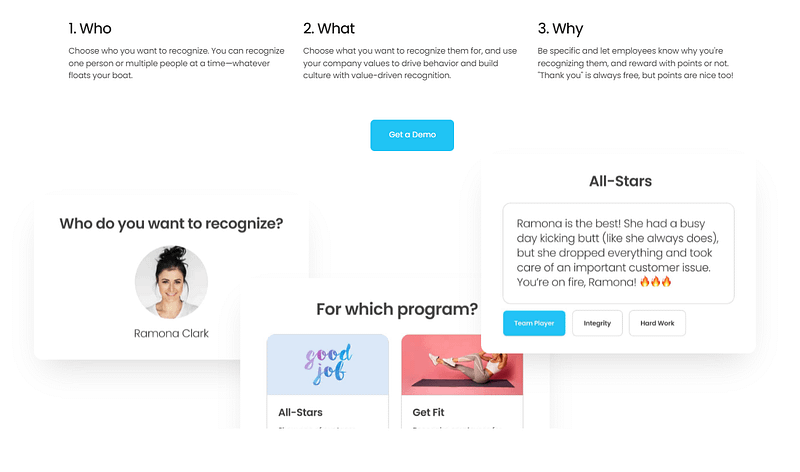
Awardco is the recognition software whose primary differentiator is its Amazon Business integration. The reward marketplace pulls from Amazon’s SKU base, which gives buyers catalog breadth right out of the box. Recognition runs on a points-based model. Service awards, milestone celebrations, and bulk recognition campaigns are first-class workflows, and pricing is custom.
Best for: SMB-to-enterprise organizations that want a broad Amazon-backed rewards marketplace as the core of their recognition program, with a single-vendor admin experience.
Key features
- Amazon Business catalog integration–millions of SKUs
- Points-based recognition with peer, manager, and bulk award flows
- Service award and milestone celebration programs
- Integrations with Slack, Microsoft Teams, Workday, ADP, and Namely
- Vendor-style admin dashboard with budget controls
Strengths
Catalog breadth from Amazon’s SKU base. Simple admin–one vendor, one invoice, one dashboard. The Amazon partnership signals enterprise credibility to procurement. For buyers who only need a points-and-marketplace economy, setup is fast and cost-per-employee is predictable.
6. Nectar HR: Mid-market values-based recognition

A clean values-tagged kudos feed is a great start. It isn’t a global recognition program.
Nectar HR is the mid-market recognition platform built around values-tagged peer-to-peer kudos. It pairs recognition with light engagement tooling and prices for mid-market HR budgets. Pricing runs around $2.75–$4 per user per month, and the platform is built primarily for U.S.-centric mid-sized companies rolling out a culture program quickly.
Best for: mid-sized companies (100–1,000 employees) focused on values-based culture rollout with peer recognition as the centerpiece.
Key features
- Peer recognition tagged to company values
- Customizable rewards catalog (gift cards, branded swag, Amazon items)
- Nomination and challenge programs tied to wellness or engagement initiatives
- Automated milestone and birthday recognition
- Internal communication tools for company-wide updates
Strengths
Clean UX. Fast adoption. The all-in-one positioning lets mid-market HR teams stand up recognition plus light engagement in one platform without a six-vendor evaluation. For an HR team of one, time-to-first-recognition is short.
7. Mid-market values-based Recognition Softwares

Best for: Mid-sized companies running culture-program rollouts. Teams that want clean UX and fast adoption on the recognition feed. Values-driven cultures where the program manager is also the chief evangelist.
Pricing: Mid-market per-seat-per-month, typically $3 to $7 per user.
Key features: Values tagging on each kudos, kudos feed, recognition templates, light analytics, basic gift-card redemption, Slack and Teams notifications, peer-nomination flows for spot bonuses.
Strengths: Clean UX. Fast adoption. The first 90 days tend to look great because the social feed gives instant gratification. Values alignment is well-handled in the feed; teams can see how recognition maps to “Customer Obsession” or “One Team” at a glance. Comfortable to deploy in a mid-market HR org without a dedicated program manager.
Watch-outs: No physical-fulfillment infrastructure. Points typically redeem in a generic catalog or for gift cards. Global delivery is weak, which means the recipient in Bogotá ends up with a different program experience than the one in Boise. The recognition program is real, but the moment that arrives at the door is thin, which surfaces in employee experience surveys two years in. Per-seat-per-month pricing scales linearly with headcount, so the cost story flips somewhere around 1,000 employees.
8. Slack-native peer-bonus Softwares
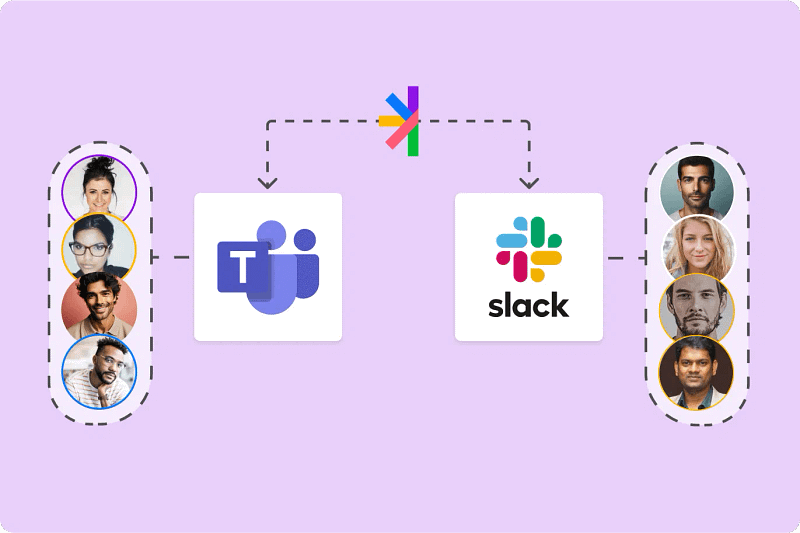
Lightweight tools that live primarily in Slack or Microsoft Teams. Employees give each other small points or coins for a job well done. The pitch is friction-light, the price is friendly, and the first quarter usually goes great.
The honest read: these are a fine entry-level layer for small to mid teams that want peer recognition in Slack without standing up an HR-led program. Pricing is typically $2 to $4 per user-per-month, setup takes an afternoon, and adoption in the first 90 days tends to feel genuinely delightful because the in-app experience is fun when it’s new. No HRIS integration required to get started. Low risk for a pilot.
Where it gets thin is later. Recognition stays digital, with physical fulfillment either bolted on or absent. Points often expire. The redemption catalog is shallow and gift-card heavy. Capability runs out quickly for enterprise programs and global teams. By month nine, the novelty fades, employees notice that the points expire and the catalog is the same three options, and recognition activity plateaus. The per-user pricing also ages poorly: it scales linearly with headcount at the same point capability runs out.
9. Service-award and milestone-focused legacy platforms

Legacy enterprise platforms anchored in service-award and milestone programs. Strong on 5, 10, 15, and 25-year tenure recognition.
Best for: Large legacy enterprises with deep service-award programs and tenure-rich workforces. Industries where 25-year tenure is still common: utilities, manufacturing, financial services, public sector.
Pricing: Enterprise custom. Often baked into broader HR-services contracts.
Key features: Service-award catalogs, glass awards, milestone certificates, manager-quote libraries, tenure-program reporting, custom event coordination, engraving and physical-award production.
Strengths: Real depth on tenure recognition. A mature service-award catalog. Comfortable for HR leaders running long-running tenure programs. The platform handles the moments where the company wants to send a Tiffany clock or a personalized engraved award without coordinating with three vendors. Strong reporting on multi-decade tenure cohorts.
10. Group-greeting-card and collaborative appreciation platforms

Collaborative digital greeting-card tools. Teammates sign a shared card for a birthday, farewell, or milestone, often with a small gift card attached. The category does what it says it does: it adds a social touchpoint to a moment.
That’s the strength and the limit. A signed card is genuinely fun. It’s cheap. Pricing is per-card or a low annual subscription, usually under $10 per card. There’s no implementation project. Useful as a complement inside a broader recognition program.
The trouble is what it doesn’t do. No program structure. No physical fulfillment beyond the gift-card attachment. No HRIS connection, so the platform can’t trigger off employee milestones, and every card is a manual sender effort.
Once a team scales past 200 employees, the card-by-card model gets admin-heavy.
And in the global case, the HR team often ends up shipping the actual gift themselves alongside the card, which lands you back at the apartment-as-warehouse problem.
11. Frontline and deskless workforce recognition apps
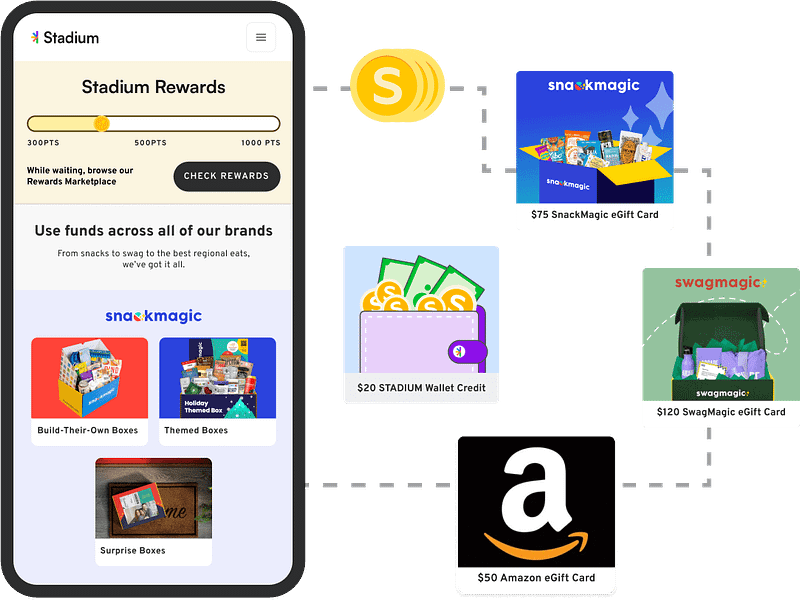
Mobile-first recognition tools designed for deskless and frontline workforces in retail, hospitality, and manufacturing.
Best for: Organizations with large mobile-only workforces who don’t have email or laptop access. Retail chains. Restaurant groups. Manufacturing operations. Field-service and logistics teams where recognition has to live in the same app the employee already uses for shifts.
Pricing: Per-employee-per-month, often bundled with broader workforce-management licensing.
Key features: Mobile app, scheduling and time-tracking integration, simple peer rewards, light reporting, shift-based notifications, manager-driven recognition with optional points or vouchers.
Strengths: Built for the deskless reality. A mobile-first UX that frontline employees actually open. Often paired with workforce-management tooling, so the recognition layer rides on top of an app the employee opens daily. Useful for high-frequency, low-value peer recognition.
12. Engagement-survey-led recognition platforms

Engagement and culture platforms with recognition added as a feature. Built around eNPS surveys, performance reviews, and pulse engagement data.
Best for: Companies that want recognition embedded inside a broader employee experience suite alongside surveys and performance. Organizations where engagement-survey strategy is the primary HR investment and recognition is a complementary use case.
Pricing: Custom or per-seat, typically bundled with the survey and performance modules.
Key features: Surveys, pulse engagement, recognition layer, performance integrations, manager dashboards, roll-up reporting tying recognition activity to engagement scores.
Strengths: Integrated employee experience analytics. Surveys plus recognition in one place. The data correlation (recognition activity vs. eNPS) is useful for HR leaders building the engagement narrative for the board. A single vendor for survey and recognition reduces procurement overhead.
How to choose: a 4-step decision framework
Buyers walk into demos with the wrong shortlist roughly half the time. The demos aren’t the problem. The criteria got set before the audience, vendor footprint, and delivery requirements were mapped.
The 4-step framework below is what we walk Penny Olsen and Jessica Rose through when they ask how to evaluate. Run it before the first demo and the shortlist sorts itself.
Map your audiences
List every audience the program will serve. Employees alone? Employees plus clients on renewal cycles? Plus partners on co-marketing campaigns? Plus prospects in an ABM motion?
The answer determines whether you need an employee-only platform or a multi-audience platform. Be honest about future state. Most teams pick employee-only because the immediate use case is recognition, then inherit a sales-gifting tool 18 months later, and a client-thank-you tool the year after. Four vendors. Four logins. Four invoices. One fragmented engagement strategy.
The fix: list every group you'll send a recognition or thank-you to in the next 12 months. Map all four audiences before you sign anything.
Stadium serves employees, clients, partners, and prospects on one platform. If your 12-month list includes more than employees, that's the criterion that narrows the shortlist fast.
Audit your current vendor footprint
Inventory every tool currently sending gifts, swag, snacks, or recognition to anyone. HR, Sales, Marketing, Events, Operations.
Count the vendors. Count the logins. Count the invoices.
The current vendor count is the buying criterion. A Chief of Staff with 8 vendors has a consolidation opportunity, not a recognition tool problem. The buying decision flips from "which platform" to "which platform consolidates the most vendors." The math gets clear quickly.
"We cut 9 vendors, saved a ton of money, and took our engagement to an all-new level." – Nish P, CEO at Paperchase
Count the vendors. The number is the case for consolidation.
Define your delivery requirement
Write down what "recognition delivery" means in your program.
Is it a Slack post and a digital points balance? A gift card emailed quarterly? A swag kit at onboarding plus a snack box for milestones plus a curated gift for service awards? The delivery format requirement is the criterion most buyers under-specify in RFPs, and it's the reason programs launch with thin delivery and leadership wonders why engagement metrics didn't move.
Recognition. Swag. Snack boxes. Gifting. Pick the delivery formats your program needs.
A points balance is not a recognition program. The thing that arrives is.
Run a 30-day pilot, measure what mattered
Pilot the platform for 30 days with one team or one program.
Track four things. Time-to-first-recognition: how long from kickoff to the first kudos or gift sent. Recognition coverage in the cohort: percent of the pilot group recognized. Recipient satisfaction: a one-question survey asking how the recognition felt. Admin time spent: hours per week the HR team puts into the program.
This is the only way to know what the contract will feel like, not what the demo promised. Buyers who sign annual contracts on demo impressions discover the reality six weeks later, when the HR team has burned three afternoons on workflow corrections.
Keyfactor is a global cybersecurity SaaS company with recipients in Sweden, Germany, France, the U.S., Spain, Canada, and more. Nine-plus countries in active rotation. Before Stadium, Keyfactor used a local swag vendor that shipped globally but didn't fulfill locally, which meant hefty international fees, returned mail, and Megan Caldwell, Keyfactor's Global Employee Experience Specialist, managing inventory across borders.
After switching to Stadium, Megan stood up a branded recognition program called KEYkudos. Managers receive 2,500 KEYkudos to give quarterly, individual contributors receive 1,250. She automated milestone anniversaries from 3-year to 25-year tenure, set up onboarding swag kits triggered from UKG (the new hire gets an email to redeem a kit the moment they're added to HRIS), and ran the May Movement Challenge wellness program with snack box rewards. By the time the program was running at full strength, Keyfactor had built 50+ Stadium Shops and 20+ automations across nine-plus countries. One month logged 1,000 posts of praise.
"If you're looking for a platform that has it all, Stadium's a great option. With recognition, swag, gift cards, and experiences, it's a catch-all for everything, whereas before, we had so many different platforms for so many different things." – Megan Caldwell, Global Employee Experience Specialist, Keyfactor
Ready to Set Up Your Recognition Program in Minutes?
Employee Recognition Solution
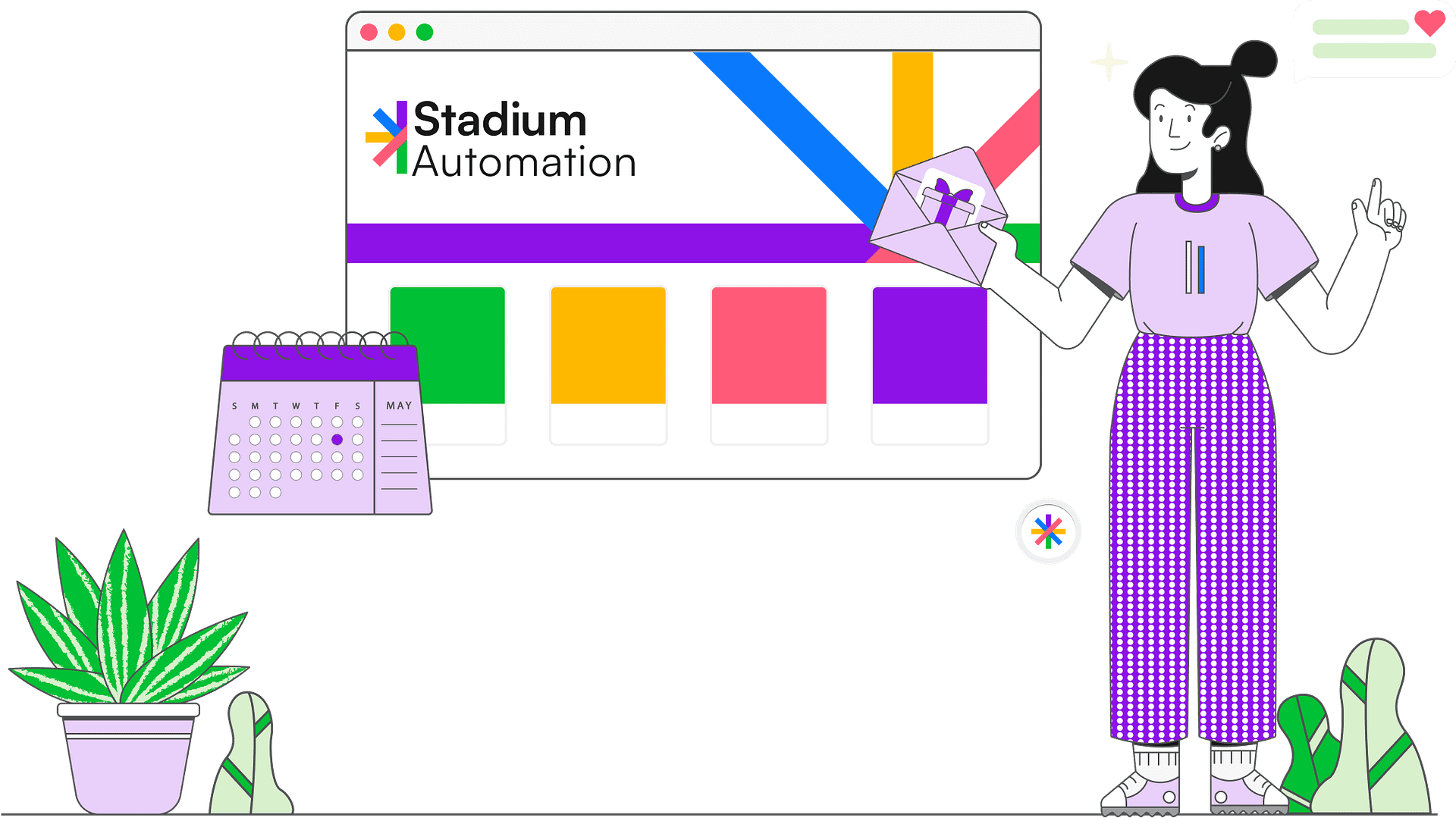
Stadium's Automation Dashboard makes this structure practical
Stadium makes it easy to build a curated gift shop, set a per-person budget, and send personalized gift links to your whole team — in-office and remote — without collecting a single home address.
No vendor juggling.
No logistics headaches.
Choice-based experience every admin wants to redeem.
See Stadium in Action
Your do-it-all platform for Rewards. Global Solution
Stadium helps companies operationalize exactly that by building recognition programs, automating milestone moments, and delivering rewards to intern cohorts anywhere in the world, all from one platform.
Whether you’re running ten interns or a hundred, the workflows scale without the administrative lift.
Recognition runs through all of it. Not as a bonus layer added at the end, but as a practical engagement tool that keeps interns feeling connected, valued, and motivated throughout a program that moves quickly.
Integrations
Automate Your Workflow
Salesforce
Send Stadium points for newly updated Salesforce records.
Marketo
Send points to Stadium shops for new leads in Marketo.
Workable
Send Stadium points to new candidates in Workable.
Greenhouse
Send Stadium shop points for new scheduled interviews in Greenhouse.
BambooHR
Send points to Stadium shops when new employees start in BambooHR.
Hibob
Send Stadium points for new Hibob employees.
Cvent
Send Stadium points for new or updated Cvent attendees.
Patreon
Send points to Stadium shops for new member pledges in Patreon.
Bonusly
Send Stadium points for new Bonusly bonuses.
2,000+ integrations with Zapier
Streamline your gifting with Zapier.
View all integrations
We integrate with hundreds of HRIS, ATS, CRM and event platforms
Ready to recognize employees in ways that actually land?
From thoughtful employee onboarding gifts to local fulfillment globally, we make it easy to recognize your team, wherever they are.

